Rationale & Need
The Need for an Integrated Village Programme
Many concerns visible in rural and urban life are connected.

Integrated Rural Development
From Harmonious Families to Prosperous Villages
Location
Multi-State (Chhattisgarh, MP, Maharashtra)
Domain
Integrated Rural Development
Project Lead
SHAPE Foundation & Joint Partners
About the Project
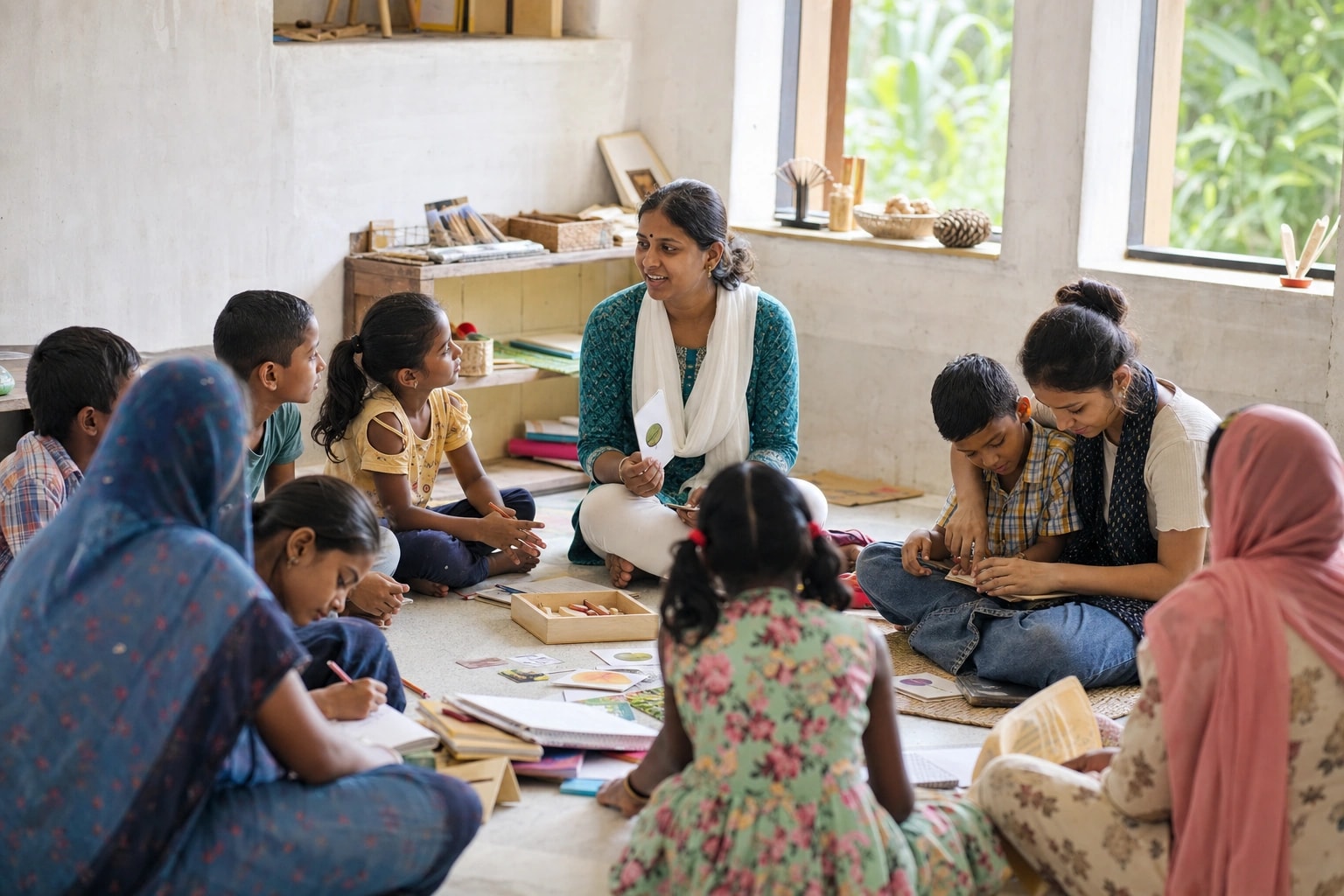
Aanandi Kutumb Samrudhha Gram, or AKSG, is a long-term programme proposed for the development of harmonious families, prosperous villages and responsible community systems.

The programme begins with Chetna Vikas Mulya Shiksha and extends into five interconnected dimensions: Education-Sanskar, Health-Sanyam, Production, Exchange-Storage, and Justice-Protection.
Its purpose is not limited to improving village infrastructure. AKSG seeks to create an environment where families live with mutual trust, villages become capable of fulfilling their needs, and human development remains complementary to nature.
The name expresses the sequence at the heart of the programme: 'Aanandi Kutumb' refers to a family that lives with happiness, trust, responsibility and sufficient physical resources. 'Samrudhha Gram' refers to a village where families participate together, local resources are used responsibly, and the five dimensions of human living are gradually fulfilled.
The programme draws inspiration from Chetna Vikas Mulya Shiksha, Madhyasth Darshan, and community-led village development practices.
AKSG remains a conceived initiative and is yet to be operationalised. Therefore, the programme’s proposed outcomes should not be presented as completed impact.
Core Work

Rationale & Need
Many concerns visible in rural and urban life are connected.

Philosophical Foundation
The programme is guided by the human goal proposed in Madhyasth Darshan:

Progression Pathway
The programme describes a four-level journey of human organisation.

Core System
1. Education-Sanskar: Consciousness development, behavioural education, and technical education. Activities include child/adult learning, parent dialogues, Jeevan Vidya intro programmes, and facilitator training.

Rural-Urban Synergy
AKSG is not designed around the assumption that villages must function in isolation from cities.

Implementation Plan
The first phase is planned as a participatory and relationship-based process:

Long-term Horizon
Years 1 to 5: Establishing community dialogues, learning programmes, resource families, youth preparation, and initial activities across the 5 dimensions.

Collaborative Coalition
AKSG is a collaborative effort involving partner institutions with deep experience in education, Madhyasth Darshan, agriculture, and village development:
Philosophical Foundation
The programme is guided by the human goal proposed in Madhyasth Darshan:
1. Resolution and happiness in every individual
2. Prosperity in every family
3. Fearlessness in society
4. Coexistence with nature and existence
These four outcomes provide a wider basis for examining village development.
Prosperity is not understood only as financial income. It includes the family’s confidence that it has, or can produce, more physical resources than it requires. Fearlessness is connected with trust and justice in relationships. Coexistence means participating with nature in a manner that protects its continuity and balance.
5 Dimensions
Education, Health, Production, Exchange & Justice
5 Years
proposed first implementation phase
20 Years
long-term development horizon
5 Orgs
joint coalition of participating institutions

Core System
1. Education-Sanskar: Consciousness development, behavioural education, and technical education. Activities include child/adult learning, parent dialogues, Jeevan Vidya intro programmes, and facilitator training.
2. Health-Sanyam: Preventive health, daily routine, clean environment, yoga, local herbal knowledge, and health camps.
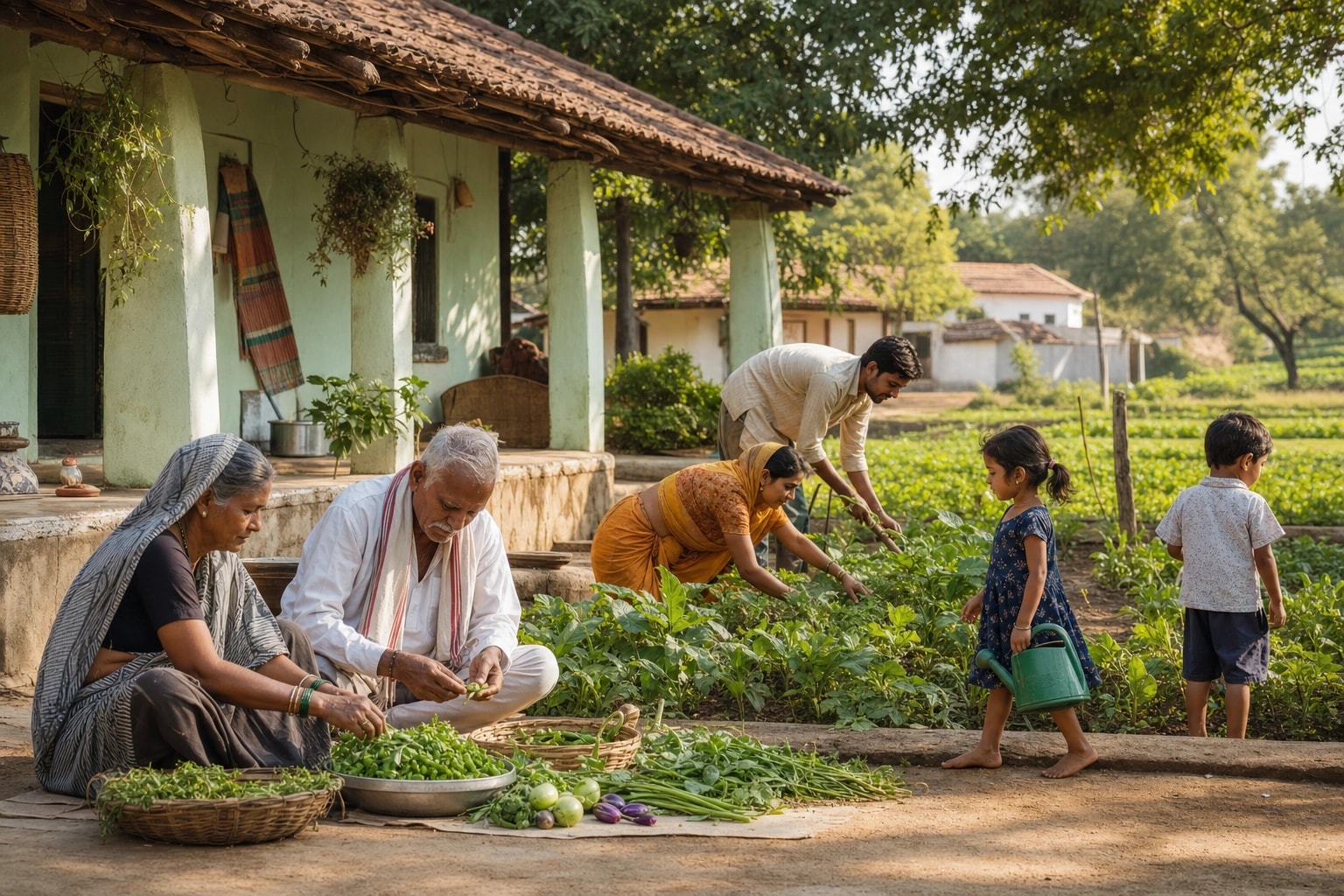
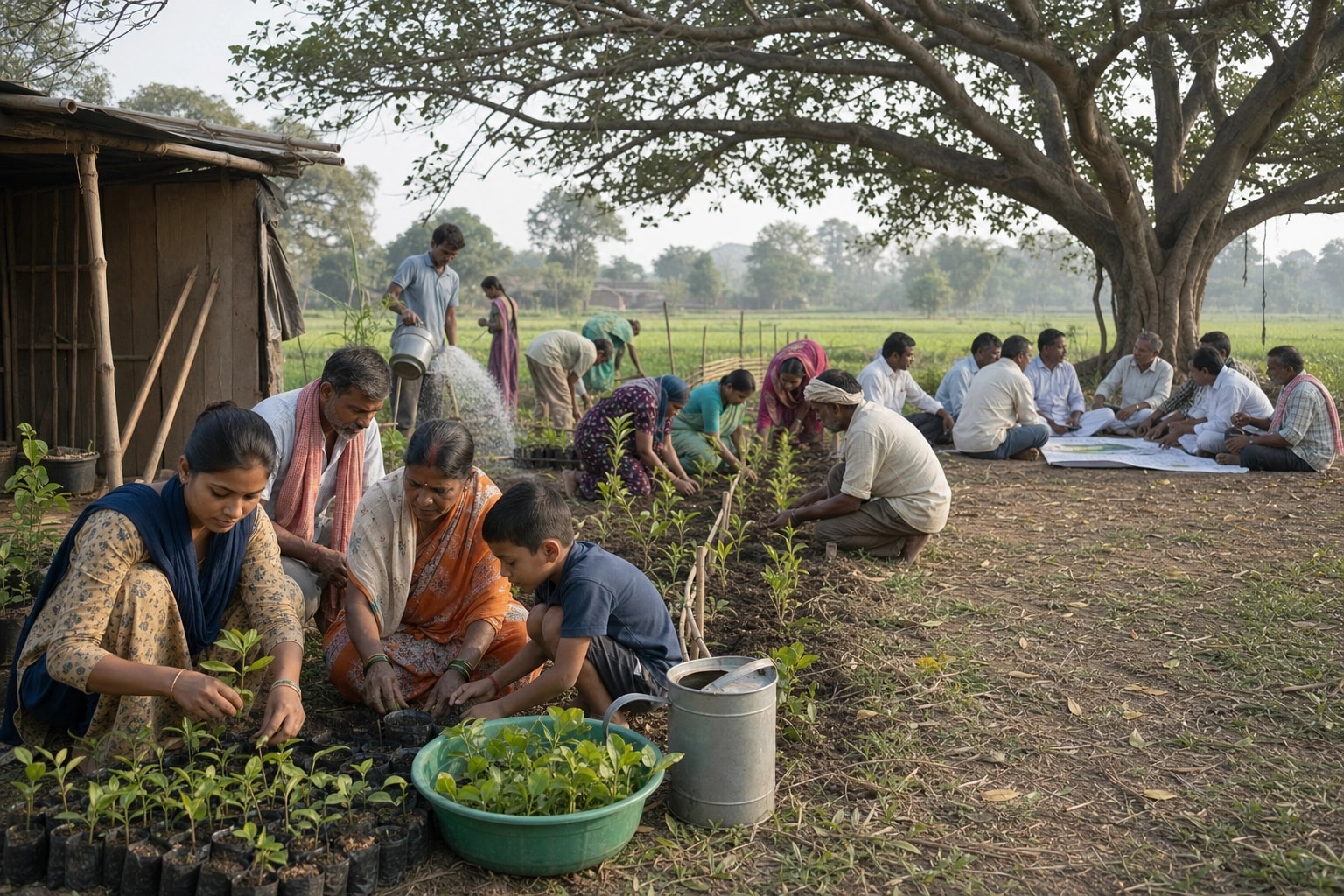
3. Production: Connecting human effort with natural resources. Activities include kitchen gardens, natural farming, local village enterprises, and dignity towards labour.
4. Exchange-Storage: Fair economic exchange, labour-based evaluation, responsible saving, village storage systems, and resource funds.
5. Justice-Protection: Recognising relationships, family assemblies, neighbourhood meetings, children's assemblies, and dialogue-based conflict resolution.
Implementation Plan
The first phase is planned as a participatory and relationship-based process:
• Village Selection – Clear criteria for identifying suitable villages and partners.
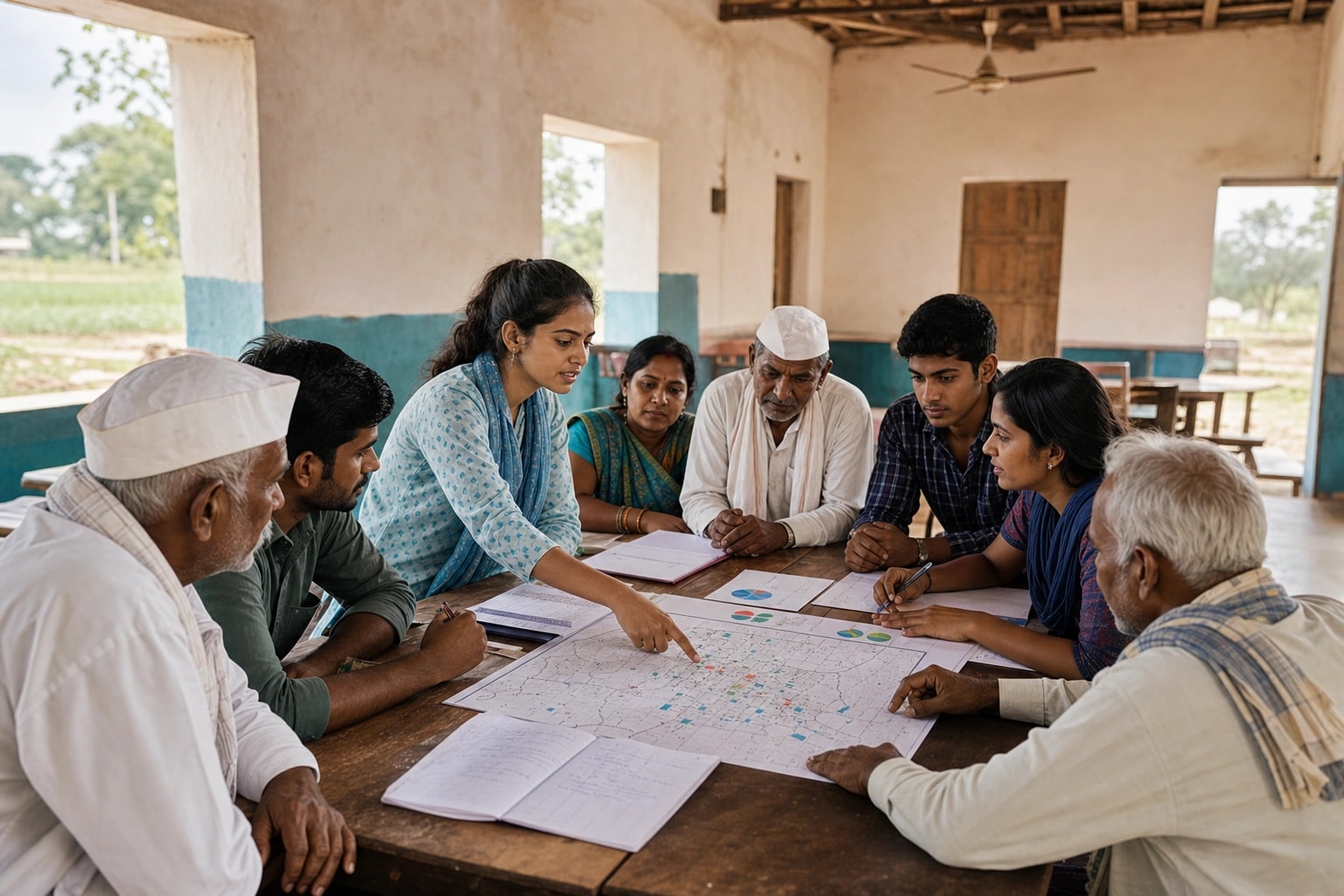
• Baseline Study – Assessing education, health, production, resources, and community institutions.
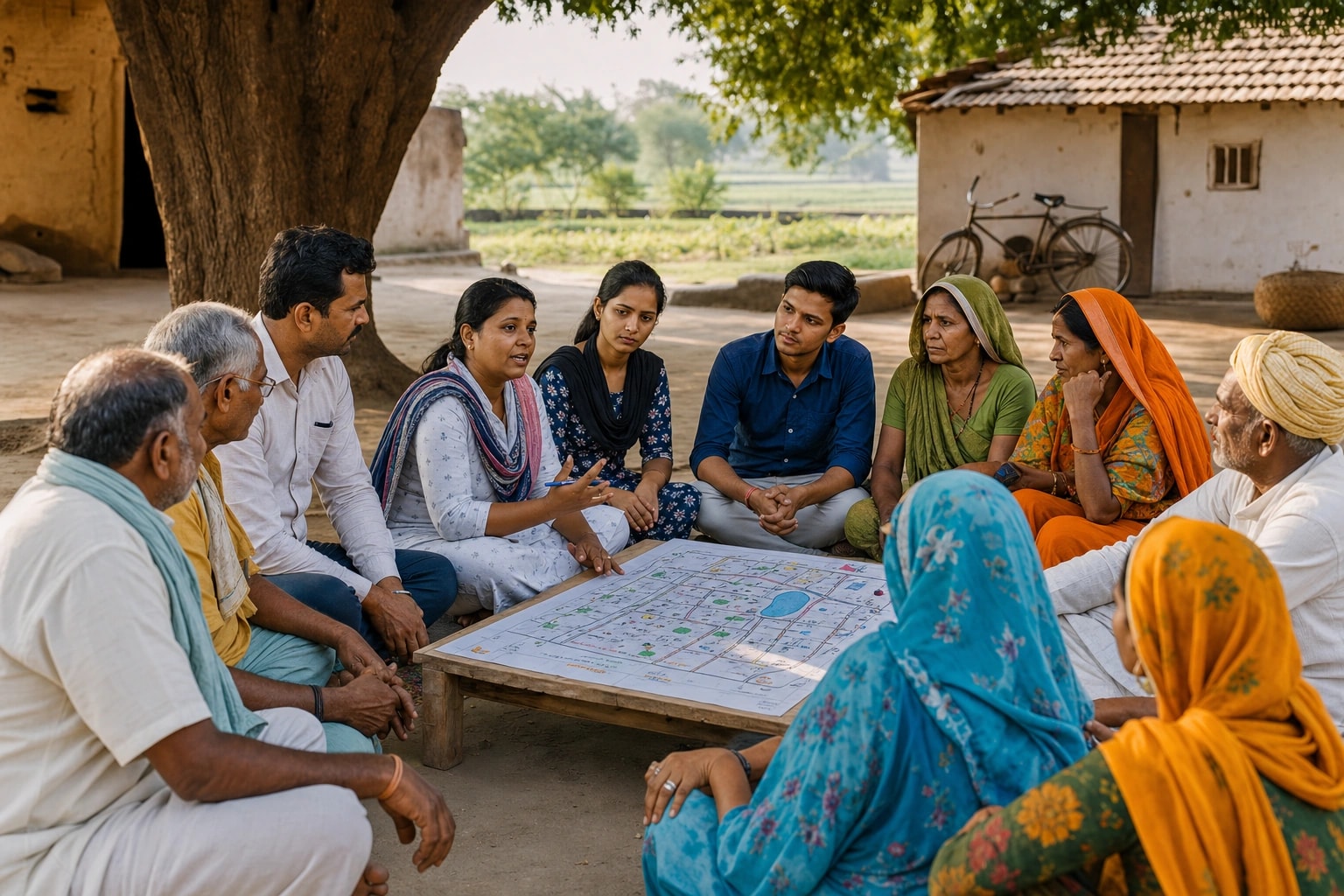
• Community Dialogue – Introductory programmes to examine purpose and direction.
• Resource Families – Identifying families willing to study and participate.
• Youth Development – Preparing local youth and educators for responsibilities.
• Regular Learning & Periodic Review.
1. Criteria-based Village Selection
2. Comprehensive Baseline Study
3. Community Dialogue & Orientation
4. Identification of Participating Resource Families
5. Youth & Educator Facilitator Development
6. Regular Learning Sessions & Periodic Review

The programme is guided by the human goal proposed in Madhyasth Darshan:
1. Resolution and happiness in every individual
2. Prosperity in every family
3. Fearlessness in society
4. Coexistence with nature and existence
These four outcomes provide a wider basis for examining village development.
Prosperity is not understood only as financial income. It includes the family’s confidence that it has, or can produce, more physical resources than it requires. Fearlessness is connected with trust and justice in relationships. Coexistence means participating with nature in a manner that protects its continuity and balance.
Resolution & Happiness in every individual
Prosperity in every family
Fearlessness & Trust in society
Coexistence & Balance with nature
1. Education-Sanskar: Consciousness development, behavioural education, and technical education. Activities include child/adult learning, parent dialogues, Jeevan Vidya intro programmes, and facilitator training.
2. Health-Sanyam: Preventive health, daily routine, clean environment, yoga, local herbal knowledge, and health camps.
3. Production: Connecting human effort with natural resources. Activities include kitchen gardens, natural farming, local village enterprises, and dignity towards labour.
4. Exchange-Storage: Fair economic exchange, labour-based evaluation, responsible saving, village storage systems, and resource funds.
5. Justice-Protection: Recognising relationships, family assemblies, neighbourhood meetings, children's assemblies, and dialogue-based conflict resolution.
1. Education-Sanskar – Consciousness development & behavioral/technical learning
2. Health-Sanyam – Preventive health, daily routine & herbal awareness
3. Production – Natural farming, local enterprise & dignity of labour
4. Exchange-Storage – Fair value exchange, responsible saving & village funds
5. Justice-Protection – Family assemblies, mutual trust & dialogue-based resolution
The first phase is planned as a participatory and relationship-based process:
• Village Selection – Clear criteria for identifying suitable villages and partners.
• Baseline Study – Assessing education, health, production, resources, and community institutions.
• Community Dialogue – Introductory programmes to examine purpose and direction.
• Resource Families – Identifying families willing to study and participate.
• Youth Development – Preparing local youth and educators for responsibilities.
• Regular Learning & Periodic Review.
1. Criteria-based Village Selection
2. Comprehensive Baseline Study
3. Community Dialogue & Orientation
4. Identification of Participating Resource Families
5. Youth & Educator Facilitator Development
6. Regular Learning Sessions & Periodic Review
AKSG is a collaborative effort involving partner institutions with deep experience in education, Madhyasth Darshan, agriculture, and village development:
Divya Path Sansthan, Amarkantak
Abhyuday Sansthan, Achhoti, Chhattisgarh
A. Nagraj Manviya Shikshan Shodh Kendra, Parada, Maharashtra
SHAPE Foundation
Yashwant Agriculture, Village and Watershed Development org (Hiware Bazar, Maharashtra)
FAQ
Partner with Us
For Gram Panchayats, voluntary organisations, educators, institutions, and supporters interested in participating in AKSG's long-term village development framework.
Phone: +91 75064 33814
Email: info@shape.earth
Support Initiative
AKSG welcomes villages, educators, institutions, practitioners and supporters interested in long-term community-led development.